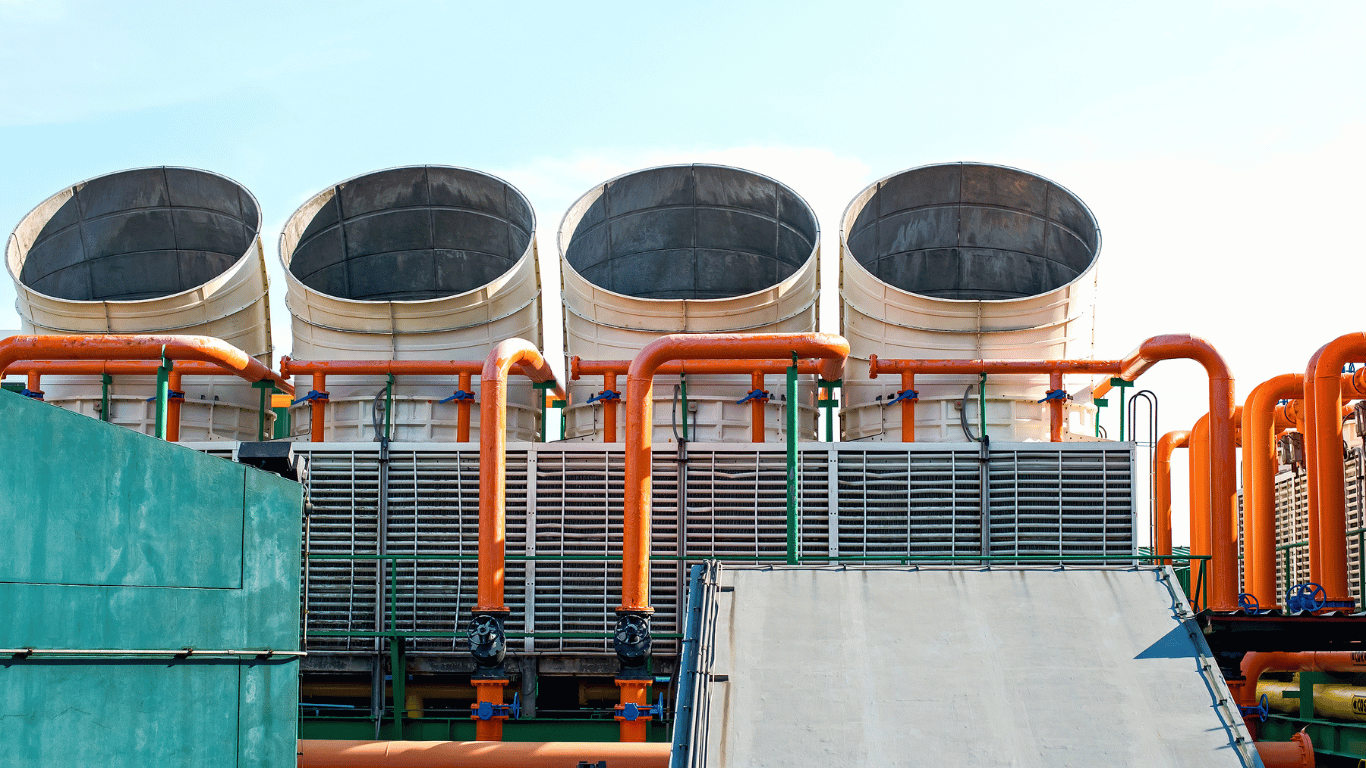
Cooling towers rely on carefully managed water chemistry to remove heat and keep connected equipment operating reliably. As water circulates and evaporates, dissolved minerals, solids, and biological contaminants can become more concentrated. Cooling tower chemical water treatment helps facilities manage these conditions before they interfere with heat transfer, equipment condition, or system performance.
Why Cooling Tower Chemical Water Treatment Matters
Cooling towers continuously circulate water through a cycle of heating, cooling, and evaporation. The evaporation process removes heat, but it also changes the chemistry of the remaining tower water. As pure water evaporates, dissolved minerals and other contaminants remain behind and become increasingly concentrated.
That concentration creates several challenges for cooling system operators. Calcium, magnesium, silica, chlorides, sulfates, suspended solids, and organic matter can contribute to scale, corrosion, fouling, or microbiological growth. At the same time, warm water and constant exposure to air can create conditions that support biological growth.
A well-designed cooling tower water treatment program keeps these conditions within manageable ranges. Instead of reacting after deposits or corrosion appear, operators can use chemical treatment, testing, blowdown, and monitoring to maintain more stable water quality.
The result extends beyond cleaner tower water. Proper treatment supports heat transfer efficiency, protects heat exchangers and metal components, helps maintain cooling system performance, and can reduce unnecessary maintenance and operating costs.
What Happens When Tower Water Goes Untreated?
Most cooling towers need some level of water treatment because evaporation naturally concentrates contaminants. Even when makeup water looks clean, it can contain dissolved minerals and other substances that become more problematic as the tower operates.
Scale formation represents one of the most common concerns. Minerals such as calcium carbonate and calcium sulfate can precipitate from concentrated cooling water and form deposits on heat transfer surfaces. These deposits act as insulation, making it harder for heat to move through the equipment. As heat transfer efficiency declines, the cooling system may require more energy to achieve the same result.
Corrosion creates another concern. Uncontrolled pH levels, dissolved oxygen, chlorides, and other chemical conditions can attack metal surfaces throughout the system. Corrosion can damage piping, heat exchangers, pumps, and other components. Over time, the damage can contribute to leaks, equipment failures, costly repairs, and shortened equipment life.
Microbiological growth also deserves consistent attention. Cooling towers provide warm, wet environments where microorganisms can multiply when operators do not maintain adequate control. Biological deposits can clog cooling water pathways, contribute to biofilm formation, and interfere with heat transfer.
Facilities that want a closer look at how biological deposits develop can also review R2J’s guide to biofilm in water.
The Main Goals of Chemical Treatment
Effective tower water treatment does not rely on one chemical or one operating adjustment. Instead, a treatment program addresses several water-quality conditions at the same time.
Scale Control
Scale inhibitors help keep dissolved minerals from precipitating and depositing on equipment surfaces. This protection becomes especially important as facilities increase cycles of concentration to conserve water.
Without adequate deposit control, scale can accumulate on heat exchangers, tower fill, piping, valves, and other areas exposed to circulating water. Even a relatively thin deposit can interfere with heat transfer and increase energy consumption.
Chemical treatment helps keep minerals dispersed or soluble under the operating conditions of the cooling tower. However, the appropriate treatment depends on the water chemistry, system design, metallurgy, cycles of concentration, and operating conditions.
Corrosion Control
Corrosion inhibitors help protect metal surfaces from aggressive water chemistry. Different cooling systems may contain different metals, so treatment must account for the materials throughout the system.
A corrosion control strategy may address factors such as pH, alkalinity, dissolved oxygen, chlorides, conductivity, and inhibitor residuals. Operators should also monitor the system over time because water chemistry can change with makeup water quality, evaporation, chemical feed, and operating conditions.
Consistent corrosion control helps protect equipment and supports longer service life. It can also reduce the likelihood of leaks and unplanned repairs.
Microbial Control
Biocides control microbial growth in cooling tower systems. Facilities may use oxidizing or non oxidizing biocides depending on system conditions and treatment objectives.
Oxidizing treatments can provide broad microbial control, while non oxidizing biocides can target organisms through different mechanisms. Some programs also use dispersants to help prevent biological material and suspended solids from accumulating on system surfaces.
Chlorine dioxide represents another treatment option for controlling microorganisms in certain cooling water applications. The right approach depends on the facility, system design, existing water chemistry, and treatment objectives.
Microbial control also supports broader water safety goals. Cooling towers can generate aerosols, so facility teams need a consistent strategy for managing conditions that could support Legionella growth. R2J also provides information on how to prevent Legionella as part of broader water system management.
pH Control
pH levels affect how other treatment chemicals perform and how water interacts with equipment surfaces. Water that becomes too acidic can increase corrosion risk, while excessive alkalinity can contribute to scale formation under certain conditions.
pH adjusters help maintain water within an appropriate operating range. Depending on the system, treatment may involve chemicals such as sulfuric acid, hydrochloric acid, or sodium hydroxide.
The correct target should come from the facility’s treatment strategy rather than a generic number. Operators need to consider water chemistry, metallurgy, inhibitor chemistry, cycles of concentration, and the specific cooling system.
Managing Makeup Water and Blowdown
Makeup water replenishes water lost through evaporation, drift, and blowdown. However, every gallon of makeup water also introduces additional minerals and other contaminants into the cooling tower.
As water evaporates, those dissolved substances remain in the circulating tower water. The concentration can continue increasing until operators remove a portion of the tower water through blowdown.
Blowdown therefore plays an important role in tower water treatment. It removes concentrated water and helps control conductivity and total dissolved solids. However, excessive blowdown wastes water and treatment chemicals, while insufficient blowdown can allow dissolved minerals to reach levels that encourage scaling and corrosion.
The goal involves finding an appropriate balance between water conservation and water quality. Facilities can improve this balance through conductivity monitoring, automated feed, controlled blowdown, and a treatment strategy matched to the actual system.
R2J’s guidance on makeup water treatment for cooling towers explains how pretreatment, chemical conditioning, blowdown, and monitoring work together to protect cooling towers.
How Cooling Tower Chemical Treatment Supports Heat Transfer
Heat transfer efficiency depends heavily on the condition of the surfaces that transfer heat between the circulating water and the equipment.
Scale deposits create an insulating layer that makes heat transfer more difficult. Biological deposits can produce a similar effect, while suspended solids and corrosion products can contribute to fouling and flow restrictions.
As these conditions build, the cooling system may need to operate longer or work harder to remove the required amount of heat. That can increase energy consumption and operating costs.
Maintaining clean heat exchanger surfaces helps the system transfer heat more effectively. Proper cooling water treatment supports this objective by controlling the chemical and biological conditions that contribute to deposits and fouling.
Chemical treatment does not replace mechanical cleaning or equipment maintenance. Instead, it works alongside those practices to reduce the rate at which problems develop and help maintain stable system performance between service intervals.
Why Cycles of Concentration Matter
Cooling tower operators often monitor cycles of concentration to understand how much dissolved material has accumulated in the circulating water compared with the makeup water.
Higher cycles can reduce water consumption because the facility can operate with less frequent blowdown. However, higher concentration also increases the amount of dissolved minerals and other contaminants in the tower water.
That creates a balancing act. The treatment program must control scale, corrosion, and microbial growth while the system operates at its intended concentration level.
Facilities should not simply increase cycles to reduce water use without considering water chemistry and treatment capacity. The correct operating range depends on the source water, tower design, chemical program, equipment metallurgy, and discharge requirements.
Consistent testing helps operators identify when chemistry begins moving outside the desired range. Conductivity, pH, inhibitor levels, microbiological activity, and other system-specific measurements can help teams make informed adjustments.
Monitoring Makes Chemical Treatment More Consistent
A chemical treatment program works best when operators know what is happening inside the cooling system.
Routine testing provides information about current water quality, while trending allows teams to recognize changes over time. A sudden conductivity increase, declining inhibitor residual, unusual pH shift, or increase in microbial activity can indicate a developing problem.
Modern control systems can make this process more consistent. Sensors and controllers can monitor parameters such as conductivity and pH and trigger automated feed or blowdown adjustments when readings reach predetermined limits.
Automated feed also helps reduce the risk of underfeeding or overfeeding chemicals. Instead of relying entirely on fixed schedules, facilities can use system conditions to guide chemical dosing.
Automation does not eliminate the need for professional oversight. Operators still need to verify sensor accuracy, review trends, inspect equipment, test water, and adjust the treatment program when operating conditions change.
Chemical Treatment and Physical Maintenance Work Together
Chemical treatment cannot correct every cooling tower problem on its own.
A tower can receive the correct chemicals and still develop operational problems if the basin contains excessive sediment, the fill has significant fouling, distribution nozzles become blocked, or other mechanical components stop functioning correctly.
Routine inspections and cleaning therefore remain important parts of a complete treatment strategy. Removing accumulated deposits gives chemicals a cleaner system to protect and allows operators to identify mechanical problems before they affect system performance.
Facilities with significant buildup may need professional cleaning in addition to their regular chemical treatment program. R2J provides cooling tower cleaning services that can complement ongoing water treatment and maintenance.
What Factors Determine the Right Treatment Program?
Every cooling tower operates under different conditions. A chemical program that works for one facility may not provide the same results in another.
Treatment decisions should consider:
- Source water quality
- Makeup water chemistry
- Cooling tower design
- System volume
- Operating temperatures
- Cycles of concentration
- Metallurgy and metal components
- Heat exchanger design
- Existing scale or corrosion
- Microbiological conditions
- Discharge requirements
- Seasonal operating changes
- Facility water conservation goals
Testing provides the foundation for these decisions. Water treatment professionals can evaluate hardness, alkalinity, conductivity, pH, chlorides, sulfates, silica, iron, microbiological activity, and other relevant parameters to determine where the system needs control.
R2J’s current cooling tower treatment approach emphasizes testing and customized treatment rather than applying the same program to every facility. The company provides treatment programs, cleaning services, compliance support, on-site testing, laboratory analysis, and Legionella-related services.
Signs Your Cooling Tower Treatment Program Needs Attention
Cooling tower operators should pay attention to changes in system performance rather than waiting for visible damage.
Common warning signs include:
- Scale deposits on heat transfer surfaces
- Increasing corrosion on piping or metal components
- Unusual water discoloration
- Rising conductivity
- Excessive blowdown
- Increasing makeup water demand
- Biological growth or slime
- Clogged strainers or distribution components
- Reduced cooling capacity
- Increasing approach temperature
- Higher energy consumption
- Unexpected leaks
- Frequent equipment failures
- Increasing maintenance costs
None of these signs should automatically point to one specific chemical problem. Mechanical issues, changes in load, airflow problems, poor water distribution, and other operating conditions can also affect tower performance.
For that reason, a proper diagnosis should look at the entire cooling system rather than focusing on chemical dosage alone.
Building a More Effective Cooling Tower Water Treatment Program
A reliable program starts with understanding the water entering and circulating through the system. Testing establishes the baseline, while system inspections identify conditions that water analysis alone cannot reveal.
The next step involves selecting treatment chemistry that addresses the facility’s actual risks. Scale inhibitors can control mineral deposition, corrosion inhibitors can protect metal surfaces, biocides can manage microbial growth, and pH control can help maintain balanced water chemistry.
After establishing the chemical program, operators should set appropriate targets for conductivity, pH, inhibitor residuals, microbial activity, and other relevant parameters. Consistent testing then confirms whether the treatment continues to perform as intended.
Monitoring and automation can further improve consistency. Control systems can help regulate chemical feed and blowdown, while ongoing review allows operators to respond when conditions change.
Finally, facilities should combine chemical treatment with routine inspections, cleaning, equipment maintenance, and documentation. This complete approach helps maintain cooling water quality, protect heat exchangers, support heat transfer efficiency, conserve water, and extend equipment life.
Steps for Better Cooling Tower Chemical Water Treatment
Start by testing the makeup water and circulating tower water to establish the system’s actual chemistry. Next, evaluate the cooling tower, heat exchangers, piping, basin, fill, and other components for scale, corrosion, fouling, and biological growth. Then, select a chemical treatment program that addresses the specific conditions identified during testing. Establish targets for pH, conductivity, cycles of concentration, chemical residuals, and microbial control, and use consistent testing to verify performance. Finally, review the results regularly and adjust chemical feed, blowdown, pretreatment, cleaning, or monitoring as operating conditions change.
R2J Chemical Services can help your facility develop and maintain a cooling tower water treatment program designed around your equipment, water quality, and operating requirements. Contact R2J today to discuss your cooling system.
Frequently Asked Questions
What does cooling tower chemical water treatment do?
Cooling tower chemical water treatment controls the conditions that can cause scale, corrosion, fouling, and microbial growth. A treatment program may use scale inhibitors, corrosion inhibitors, biocides, dispersants, pH adjusters, and other products based on the system’s water chemistry and operating requirements.
Why does cooling tower water need chemical treatment?
Cooling towers lose water through evaporation, which leaves dissolved minerals and other contaminants behind. As these substances become more concentrated, they can contribute to scale formation, corrosion, biological growth, and reduced heat transfer. Chemical treatment helps keep these conditions under control.
How often should cooling tower water be tested?
Testing frequency depends on the cooling system, operating conditions, treatment chemistry, monitoring equipment, and facility requirements. Consistent testing allows operators to identify changes in water quality and adjust treatment before problems become more serious.
Can chemical treatment prevent cooling tower corrosion?
A properly selected corrosion inhibitor can help protect metal surfaces from corrosive water conditions. However, corrosion control also depends on factors such as pH, conductivity, dissolved oxygen, chlorides, water temperature, system metallurgy, and overall treatment practices.
Does cooling tower chemical treatment reduce water consumption?
An optimized treatment program can help facilities manage cycles of concentration and control blowdown more precisely. Higher cycles can reduce the amount of water discharged, but the system still needs appropriate chemical treatment and monitoring to prevent scale, corrosion, and microbial growth.

 Ed Sobolewski
